Acquisitions.com
The Rollup Plan
Buy eight small businesses at 3× profit. Put them together. Sell one big business at 8–10×.
01The idea
One line, then everything else is just how.
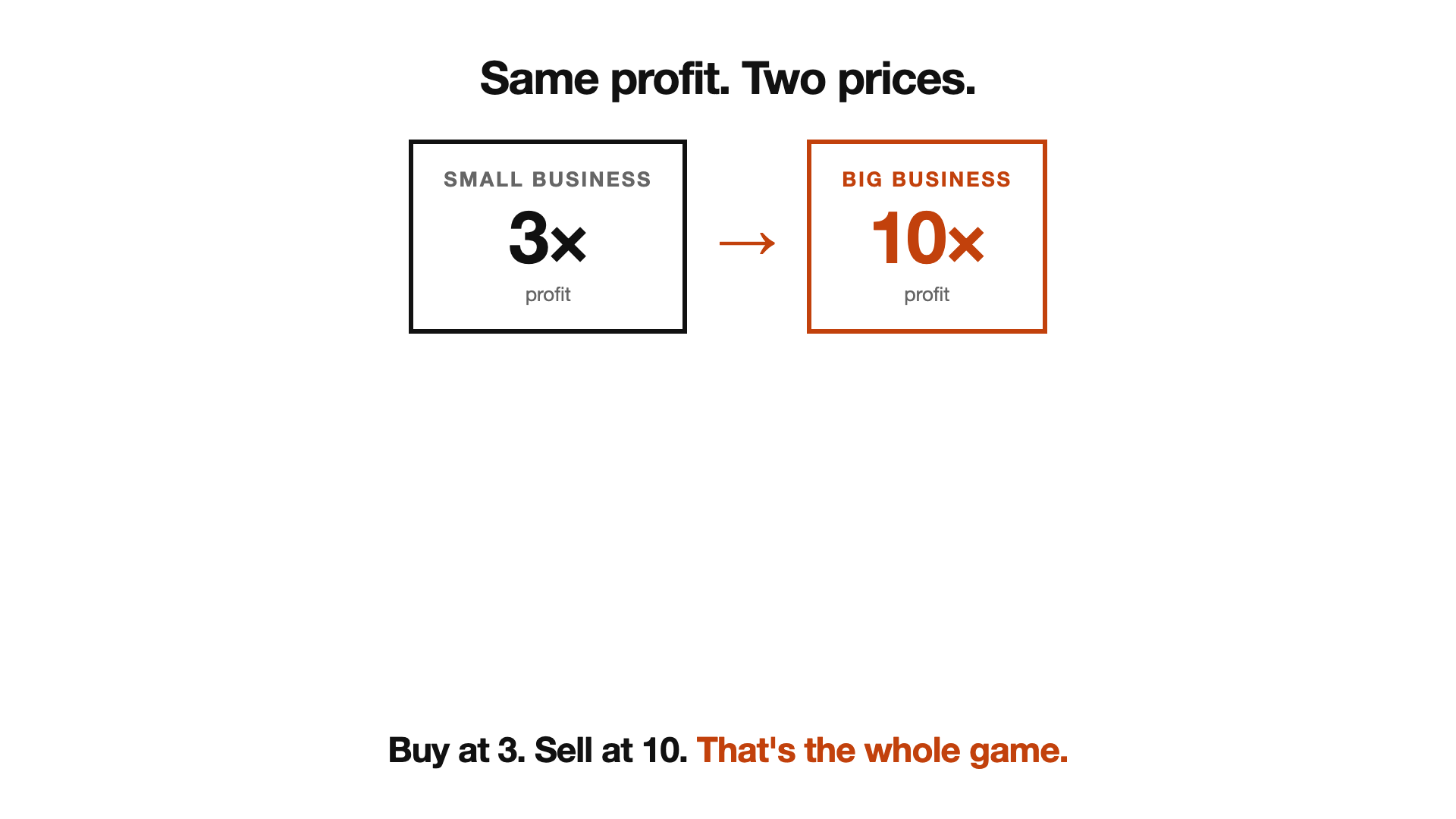
A small business sells for 3× its profit. A big business sells for 10× the exact same profit. Same trucks, same customers, same money coming in.
The price is different because a different buyer is allowed to buy it. One person with a bank loan buys the small one. Private equity buys the big one — and they pay far more.
02What we buy
Eight businesses in one industry, in one region.
| Each business | Number |
|---|---|
| Profit per year | $500,000 |
| Revenue per year | $2.8M |
| We pay | 3× = $1.5M |
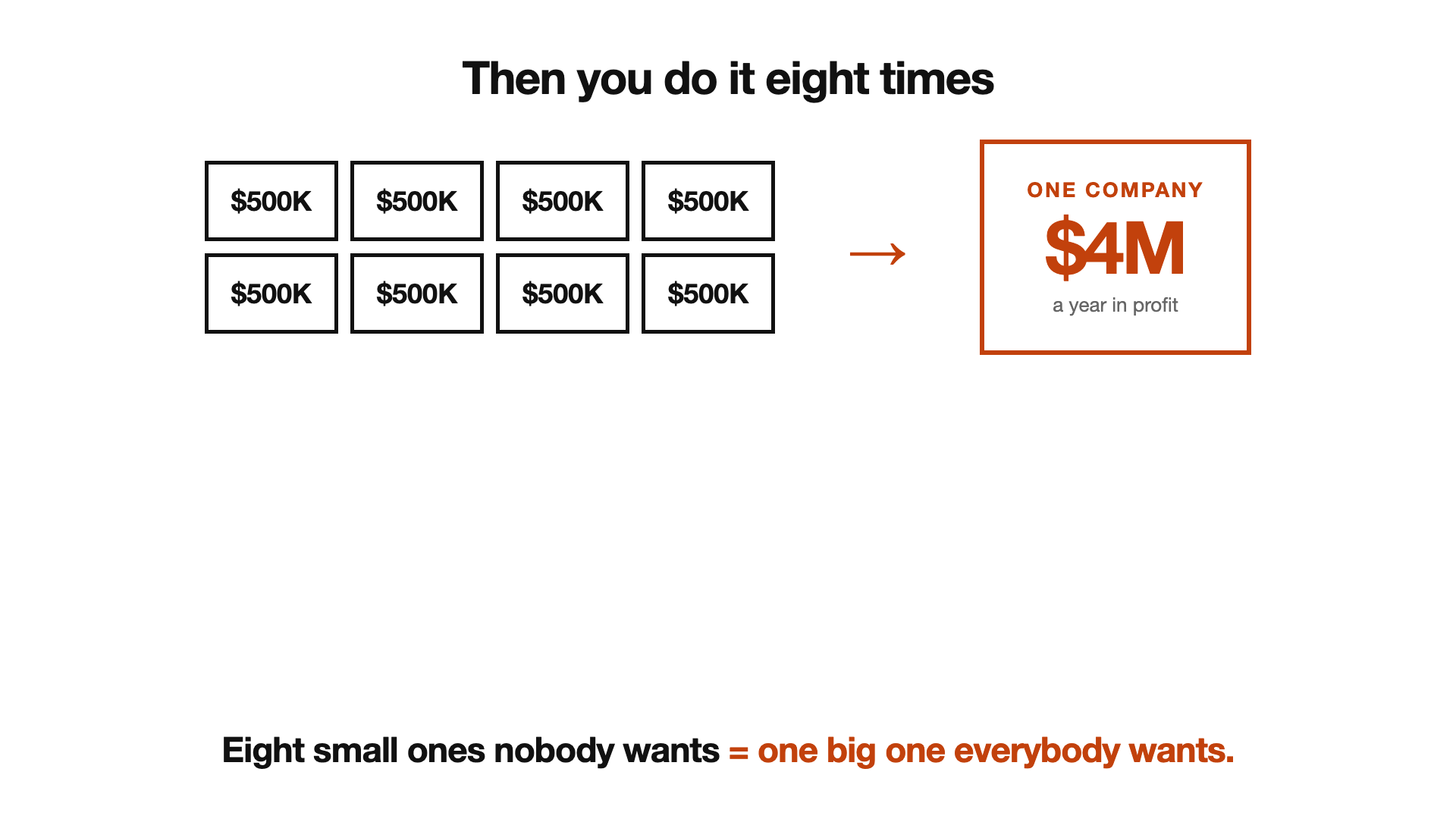
| Eight of them together | $4M profit · $22.4M revenue |
Below $1M of profit, big buyers won't look. Above $4M, they compete. That's the only reason eight is the number.
03What each owner gets
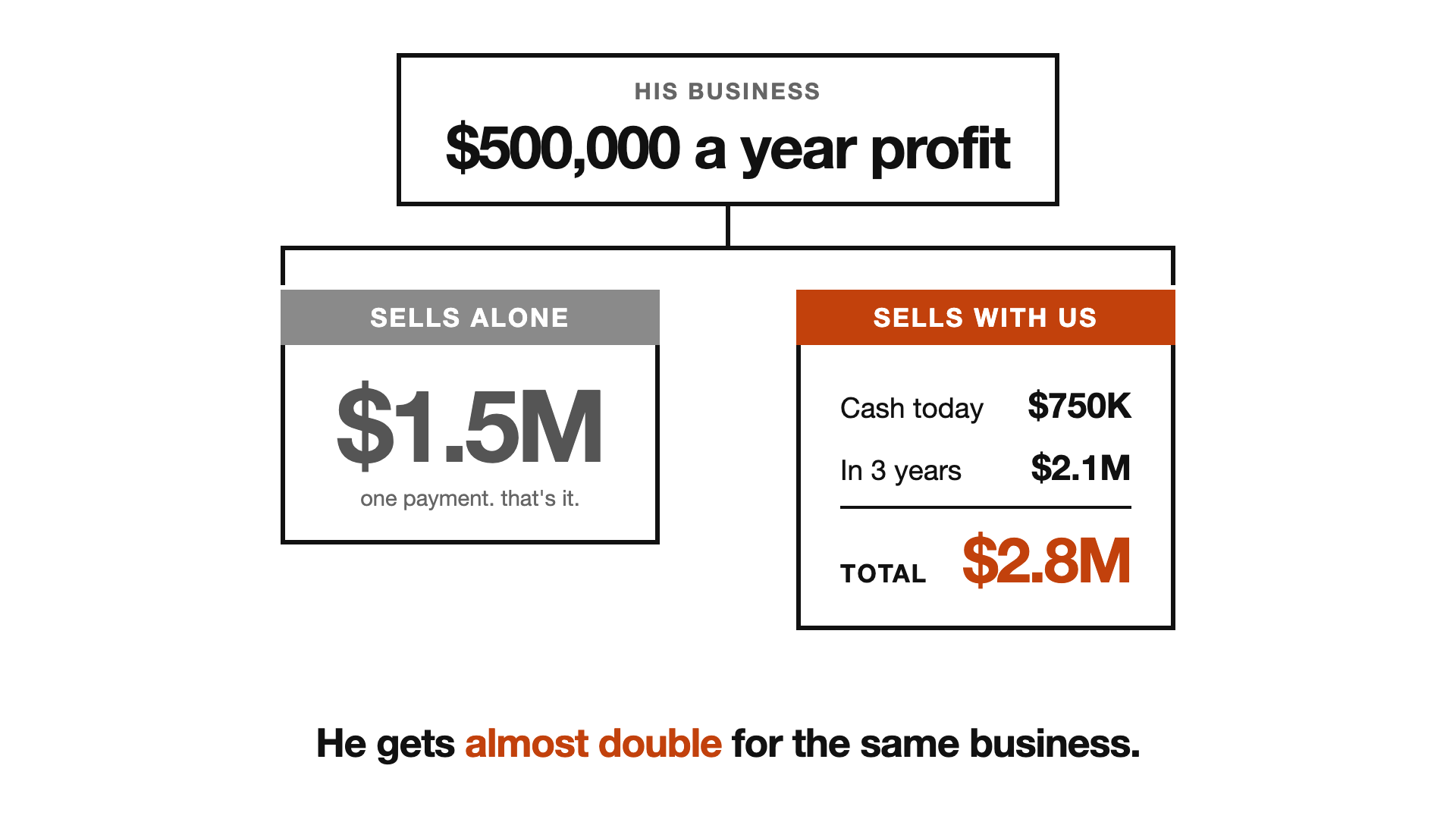
They sell half for cash and keep half in the big company.
| Alone | With us | |
|---|---|---|
| Cash at closing | $1.5M | $750,000 |
| Paid in 3 years | — | $2.1M |
| Total | $1.5M | $2.8M |
| If we sell at 10× instead of 8× | — | $3.4M |
The half they cash out is priced at 3×. The half they leave in is priced at 4.5× — a better price, because they're taking risk with us instead of taking cash.
04What investors get
They fund the cash half and the systems.
| Use of the money | Amount |
|---|---|
| Cash to the eight owners | $6.0M |
| Systems, AI, integration | $2.0M |
| Lawyers, accountants, working capital | $1.5M |
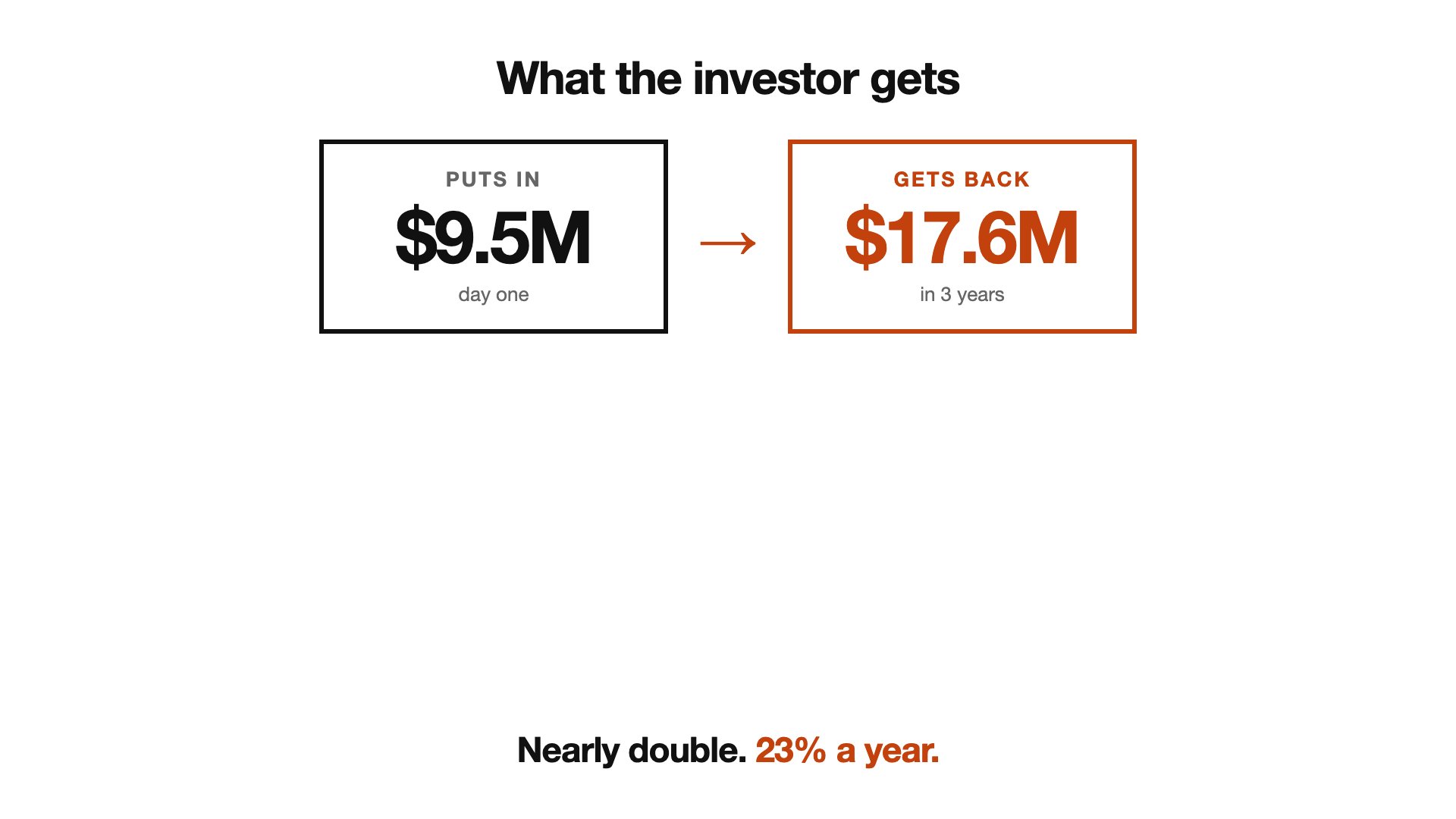
| Total raised | $9.5M |
| What they make | Sell at 8× | Sell at 10× |
|---|---|---|
| Money back | $17.6M | $22.4M |
| Per year | 23% | 33% |
We raise at 6× profit — so investors buy in at 6 while the businesses were bought at 3. Their downside protection is that the assets cost half what they paid.
05What I get
Four jobs, two ways of getting paid, no cash in.
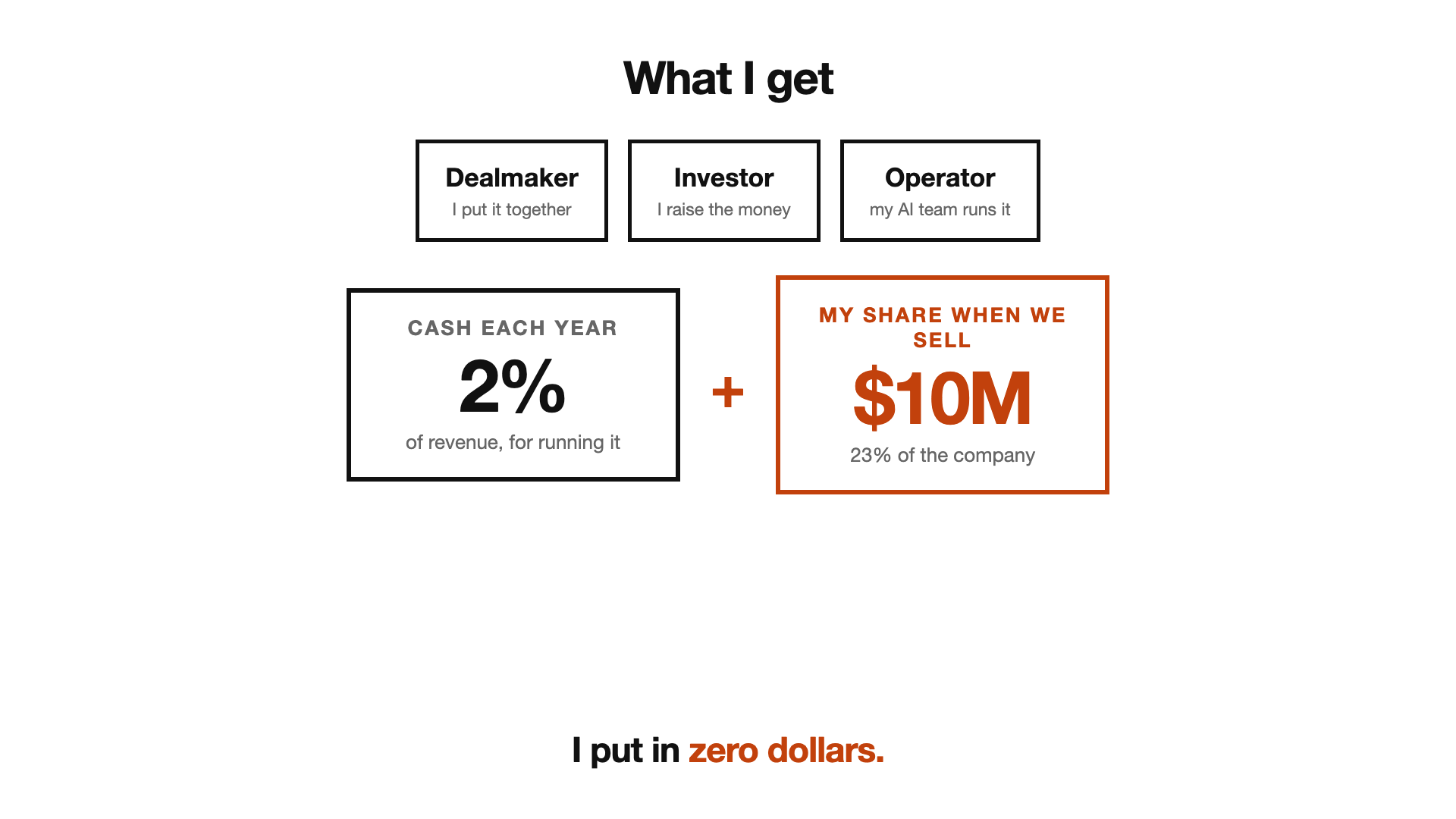
| Role | What it means |
|---|---|
| Dealmaker | Find the eight, negotiate them, close them on one day |
| Advisor | Help each owner buy well in the first place |
| Investor | Raise the $9.5M and syndicate it |
| Operator | My team and AI agents run marketing, phones, dispatch, collections, back office |
| How I'm paid | Sell at 8× | Sell at 10× |
|---|---|---|
| 2% of revenue each year, in cash | $700K | $700K |
| 22.9% of the company, at the sale | $10.2M | $12.9M |
| Total | $10.9M | $13.6M |
06Who owns the company
Marked at 6× profit on day one — $24M.
| Holder | Owns | Put in |
|---|---|---|
| The eight owners | 37.5% | Their businesses |
| Investors | 39.6% | $9.5M cash |
| Me | 22.9% | $0 |
07The group P&L
All eight businesses as one company. Every number after the 2% fee I charge.
| At close | Year 1 | Year 2 | Year 3 | |
|---|---|---|---|---|
| Revenue | $22.4M | $23.5M | $27.5M | $32.0M |
| Cost of doing the work | ($14.0M) | ($14.6M) | ($16.6M) | ($19.2M) |
| Branch overhead & managers | ($2.7M) | ($2.9M) | ($3.2M) | ($3.7M) |
| Marketing | ($0.9M) | ($1.0M) | ($1.1M) | ($1.3M) |
| Eight owners' pay (goes away) | ($0.9M) | — | — | — |
| Head office — CEO, CFO, systems | — | ($0.7M) | ($0.9M) | ($1.2M) |
| My 2% management fee | — | ($0.5M) | ($0.6M) | ($0.6M) |
| Profit (EBITDA) | $4.0M | $3.9M | $5.2M | $6.0M |
| Profit margin | 17.9% | 16.6% | 18.8% | 18.8% |
Year 1 goes down, not up. That's real. You're paying for a CEO and systems before the savings arrive. Any plan that shows profit rising in a straight line from day one is lying.
Year 2 and 3 grow three ways: 5% organic, +2 points of margin from shared buying, shared marketing and the AI systems, and three small add-on businesses bought at 4× along the way.
| Cash | Year 1 | Year 2 | Year 3 |
|---|---|---|---|
| Profit (EBITDA) | $3.9M | $5.2M | $6.0M |
| Equipment, systems build, tax, working capital | ($2.5M) | ($2.9M) | ($3.0M) |
| Cash left in the business | $1.4M | $2.3M | $3.0M |
Nobody takes money out before the sale. Cash stays in to fund the add-ons and the growth. We borrow $3.5M for the add-on purchases — that's the only debt, and it's what comes off the price at the sale.
08What everyone makes
Year 3. Same $6.0M of profit, three different sale prices.
| If we sell at | 6× (bad) | 8× (plan) | 10× (good) |
|---|---|---|---|
| Company sells for | $36.1M | $48.1M | $60.1M |
| Less the $3.5M of debt | $32.6M | $44.6M | $56.6M |
| Each owner (37.5% split 8 ways, + their $750K) | $2.3M | $2.8M | $3.4M |
| Investors (39.6%) | $12.9M | $17.6M | $22.4M |
| on $9.5M in | 1.36× | 1.86× | 2.36× |
| per year | 11% | 23% | 33% |
| Me (22.9%, + $0.7M of fees) | $8.2M | $10.9M | $13.7M |
We plan on 8×. 10× happens in good industries in good years — it's upside, not the plan. And even at 6×, the same price a buyer would pay for a business half this size, everybody still makes money.
Conservative note: at the sale we take off the $3.5M of debt but give no credit for the cash sitting in the bank. That understates every number above by a couple of million.
09How the businesses get bought
The unglamorous part. This is what it takes to buy one.
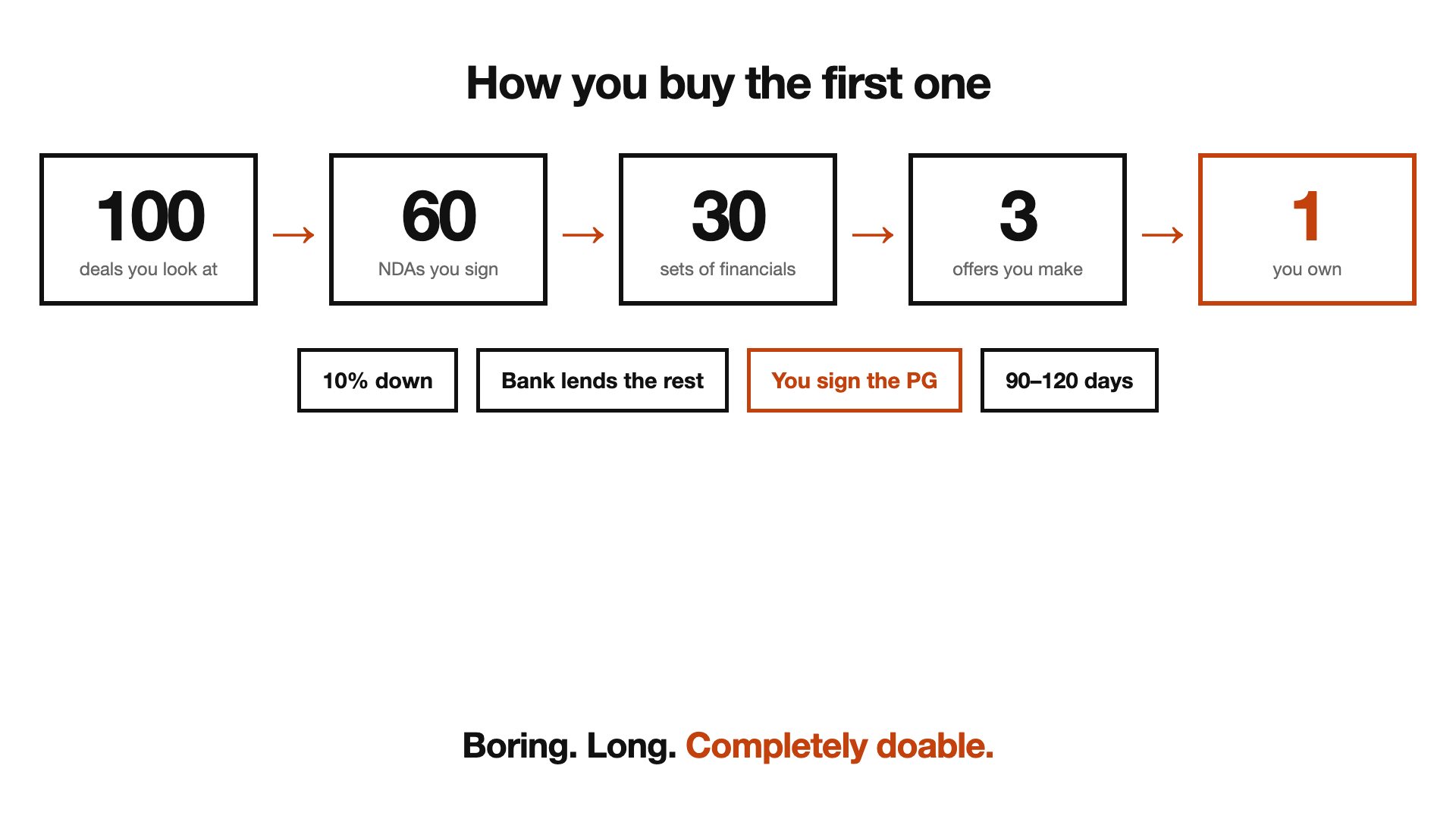
- On-market — the listing sites and brokers. Easy to find, more competition, higher price.
- Off-market — owners nobody is talking to yet. Harder, but you're the only buyer in the room. This is where 3× comes from.
- 10% down. The bank lends the rest. Sometimes the seller carries a note, sometimes we bring investors in for part of the equity.
- The buyer signs a personal guarantee. Their name is on the loan until we buy them into the platform.
- 90–120 days from handshake to owning it.
10The timeline
- Months 1–2 — Pick the industryConfirm real sales in that sector above 7× profit. Three recent deals, or pick another industry.
- Months 2–5 — Line up twelve ownersTwelve signed options for eight slots. Every owner gets their own lawyer, we pay for it.
- Months 3–5 — Hire the CEOSomeone who has run a $30M+ business in that industry. Before the raise, not after.
- Months 4–7 — Books and moneyIndependent audit of every business. Raise the $9.5M.
- Months 8–12 — Close all eight on one dayOne funds flow. Bank loans paid off, guarantees released.
- Years 1–3 — Build itAI systems across all eight. Clean combined books. Two or three small add-ons at 4×.
- Year 3 — Sell$6M of profit. 8× is $48M. 10× is $60M.
11What could go wrong
| Risk | What we do about it |
|---|---|
| Bank says no to the transfer Most owners bought with an SBA loan that has to be repaid when they sell. | Check every loan balance first. If the loan is more than 45% of our price, that owner is out. |
| We don't grow it The only case where everybody loses money. | Hire the CEO before the raise. This is the most important cheque in the plan. |
| Conflict of interest I advise people into buying, then buy from them. | Their own lawyer, paid by us. An independent valuation. Everything I make written down in front of them before they sign. |
| An owner walks at the last minute | Twelve options for eight slots. The raise is priced off a floor of six. |
| Owners take the cash and check out | Their shares vest over three years. Bonus tied to their own unit. |
12What I need to start
- Approve the searchEight weeks going through our client list to find which industry has eight qualified owners. This confirms or kills the plan.
- Approve paying for owners' lawyers and auditsAbout $90K across twelve owners. They pay nothing — that spend is what makes the options binding.
- Approve our own legal spend$150–250K for securities and M&A counsel, before the first signature.
- Pick the industryOr let the search pick it.